Threat Research
Authenticated Mailbox Abuse: 'Illuminati' Scam Campaign Leveraging Government Infrastructure
'Illuminati' scam passed SPF, DKIM, and DMARC from government servers with no links or attachments. How behavioral detection catches what authentication cannot.
By ZeroBEC Team · May 25, 2026 · 6 min read

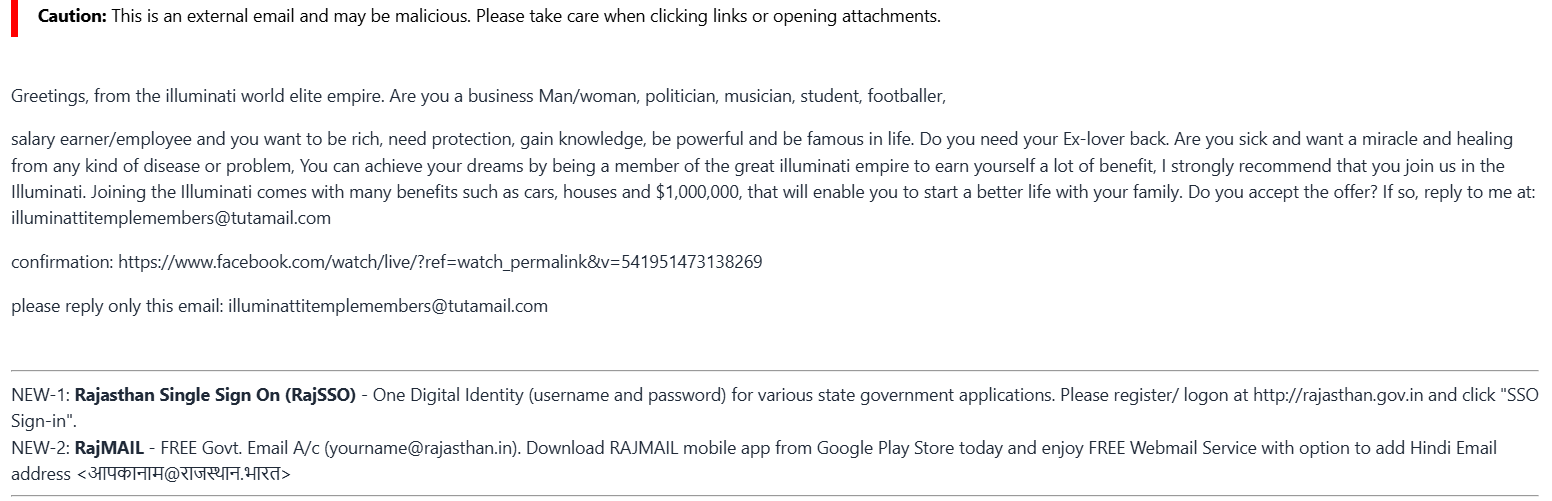
ZeroBEC recently observed a scam campaign that abused legitimate government mail infrastructure to distribute "Illuminati recruitment" emails. Unlike typical phishing, this campaign passed all three authentication checks: SPF, DKIM, and DMARC. The messages carried no malicious attachments and no attacker-controlled URLs. The entire attack surface was conversational social engineering and conversation diversion.
We found this campaign particularly notable for its abuse of authenticated infrastructure, native mail routing, and a low-technical but high-social-engineering approach that bypasses the assumptions most mail security products are built on.
How It Was Delivered
Authenticated Infrastructure, Not Spoofing
Header analysis across multiple samples revealed consistent authentication results:
- SPF: PASS
- DKIM: PASS
- DMARC: PASS
- Source: legitimate government mail servers
- Transited through Microsoft 365 infrastructure
Sender details:
- From:
******@RAJASTHAN.GOV.IN(localpart redacted) - Reply-To:
illuminattitemplemembers@tutamail[.]com - Subject: "benefits such as cars, houses and $1,000,000"
Originating IP: 103.203.136[.]15
These indicators, taken together, are consistent with authenticated use of government mail infrastructure. The most likely explanations are a compromised mailbox or a misused relay, rather than domain spoofing. We cannot determine which from the headers alone.
Content Technique: Psychological Pull Instead of Malware
The email body uses classic advance-fee scam themes:
- Invitation to join the "Illuminati world elite empire"
- Promises of wealth (cars, houses, $1M)
- Healing and personal fulfillment
- Invitation to reply to an anonymous external mailbox
There were no malicious attachments, no credential-harvesting forms, and no URLs to attacker-controlled landing pages (aside from a transient Facebook link described below). The attack vector was purely conversational social engineering.
Interesting Artifact: Facebook Livestream Link
The message referenced a Facebook Live URL:
https://www.facebook[.]com/watch/live/?ref=watch_permalink&v=541951473138269
At time of investigation, the link was unavailable, likely removed, privacy-restricted, or deleted. This pattern of short-lived social media content used as social proof is appearing more frequently in scam campaigns because it evades static reputation systems. The content is gone before any reputation feed can flag it, and the dead link looks like a clean URL to a scanner.
Why This Campaign Matters
Traditional Email Security Assumptions Break
Most mail security logic operates on a foundational assumption: if SPF, DKIM, and DMARC pass, the message is likely legitimate. This campaign directly contradicts that assumption. All three authentication checks passed, but the message was unsolicited scam content originating from infrastructure the recipient organization would never expect to flag.
No Malicious URLs or Attachments
Standard phishing filters are built around three signals: malicious links, credential-harvesting pages, and malware attachments. None existed in this campaign. The attack vector was purely conversational. There is nothing for a URL scanner, sandbox, or attachment analyzer to evaluate.
Infrastructure Abuse Over Domain Spoofing
Because the mail originated from legitimate authenticated infrastructure, domain-based reputation systems were ineffective. This aligns with a broader pattern: compromised mailboxes used to bypass filters, abuse of authenticated SMTP relays, and trusted domains used as delivery vectors. Defenders must recognize that authenticated domains can still deliver malicious content.
Detection Opportunities
Even when perimeter security misses content of this type, clear behavioral signals remain available.
Authenticated Sender with External Reply-To Divergence
The campaign's core evasion was moving communication off-channel. The From domain was a government address. The Reply-To domain was an anonymous encrypted mail provider (Tutamail). When these diverge on an authenticated message, it is a strong behavioral signal for conversation diversion, one of the defining characteristics of BEC and scam campaigns. The pattern to flag:
- Reply-To domain does not match From domain
- AND the sender passed authentication
- AND the Reply-To resolves to an external, consumer-grade, or encrypted mail provider
Semantic Indicators
The language in this campaign, wealth promises, exclusive membership offers, personal-benefit claims, aligns closely with known advance-fee and social engineering patterns. Semantic scoring can reliably flag this content category even when URLs and attachments are absent.
Transient Social Proof URLs
Short-lived social media pages or livestreams referenced in scam emails should be treated with elevated suspicion, not dismissed because the link appears clean. A URL to a Facebook Live event that returns 404 at investigation time is not evidence of a benign message. It is evidence of the short-lived social proof pattern. Third-party video IDs, transient accounts, and missing-on-click content are indicators of abuse rather than legitimacy.
Operational Guidance
Based on telemetry and investigation of this campaign:
Quarantine by behavior, not infrastructure alone. Passing SPF, DKIM, and DMARC should not auto-approve delivery without additional behavioral scoring. Authentication tells you the message is authentic to its sender. It does not tell you the sender's mailbox is operating legitimately.
Score reply-to divergence and semantic risk together. A government sender with a Tutamail reply-to and wealth-promise language is high-confidence scam content regardless of authentication state.
Hunt on Reply-To domains at external encrypted mail providers. Tutamail, Proton, and similar services appear frequently in scam and BEC reply-to headers. These are legitimate services being abused for off-channel communication diversion.
Monitor authenticated mailbox patterns. Spikes in outbound volume, unusual semantic profiles, or high proportions of unknown recipients on otherwise authenticated infrastructure are indicators of compromised or misused mailboxes at the sending organization. If your organization receives recurring mail from a legitimate domain exhibiting these patterns, consider an abuse report to that domain's security contact.
Educate security operations. Scams arriving from within trusted or authenticated domains are increasingly common. Policy decisions must consider intent and behavioral context, not just authentication headers and URL reputation.
Coordinated Response
We reported this campaign to CERT-In (India's Computer Emergency Response Team) with full technical details: message headers, originating IP, Reply-To address, and representative message samples. This gives CERT-In the information needed to investigate the source infrastructure and work with the affected organization to remediate the compromised or misused mailbox.
If you observe mail exhibiting this pattern from government-affiliated senders in any jurisdiction, we recommend routing a report to the relevant national CERT alongside any affected mail provider or government IT contact.
Indicators of Compromise (Defanged)
Mail characteristics:
- From domain:
RAJASTHAN.GOV.IN(legitimate government domain; attributed to compromised or misused mailbox) - Reply-To:
illuminattitemplemembers@tutamail[.]com - Subject pattern: promises of financial reward, exclusive membership, or personal benefits
- Originating IP:
103.203.136[.]15 - Transient social proof link:
https://www.facebook[.]com/watch/live/?ref=watch_permalink&v=541951473138269(removed at time of investigation)
Behavioral indicators for SOC hunting:
- Inbound message where Reply-To domain differs from authenticated From domain, with reply-to resolving to a consumer or encrypted mail provider
- Authentication pass (SPF, DKIM, DMARC) combined with advance-fee or social engineering semantic content
- References to short-lived or unavailable social media content used as legitimacy proof
Conclusion
This "Illuminati recruitment" campaign illustrates the evolution of social engineering attacks. It sidesteps traditional phishing markers entirely. There are no malicious links, no attachments, and no spoofed domains. It relies on authenticated infrastructure, psychological manipulation, and a reply-to designed to move the victim to a channel where no enterprise security tool can observe the conversation.
As attackers continue to leverage trusted and compromised mail infrastructure, defenders must treat behavior, content, and conversation flow as first-class detection signals rather than deferring to authentication headers and URL reputation alone.
ZeroBEC continues to track these trends as part of our ongoing effort to detect modern phishing and BEC attack vectors. Ready to see behavioral detection in action? Start free or contact us.